


Protein-Membrane Research
Antimicrobial Peptides
Antimicrobial resistance (AMR) is one of the most urgent global health challenges, threatening the effectiveness of many existing anti-infective therapies. In 2019, bacterial AMR was directly responsible for 1.27 million deaths and was associated with 4.95 million deaths worldwide, highlighting the urgent need for new therapeutic strategies. Antimicrobial peptides are a promising class of molecules for the development of next-generation anti-infective, anticancer, and membrane-targeting agents.
By rationally tuning peptide sequence, charge, amphiphilicity, hydrophobicity, flexibility, and length, we design peptides that can selectively interact with bacterial, viral, or cancer-cell membranes. These peptides may act by translocating across membranes, destabilizing lipid bilayers, or forming membrane-spanning pores that disrupt cellular homeostasis. Using multiscale molecular simulations, we systematically investigate peptide–lipid interactions and identify the molecular features that control membrane selectivity, pore formation, translocation, and biological activity.
Our computational designs are experimentally validated in-house in our BSL-2 laboratory by a dedicated research staff. We are advancing de novo designed pore-forming peptides and antimicrobial peptide nanopores, including candidates that have shown potent antimicrobial and anticancer activity, low toxicity toward human cells, and promising anti-infective activity in preclinical mouse models. In parallel, we are developing cell-penetrating and translocation-enhancing peptides for molecular cargo delivery. Together, these molecular insights support the rational design of new membrane-active peptides with applications in medicine, biotechnology, topical formulations, and disinfection.

Curvature Sensing and Membrane Modulating Proteins
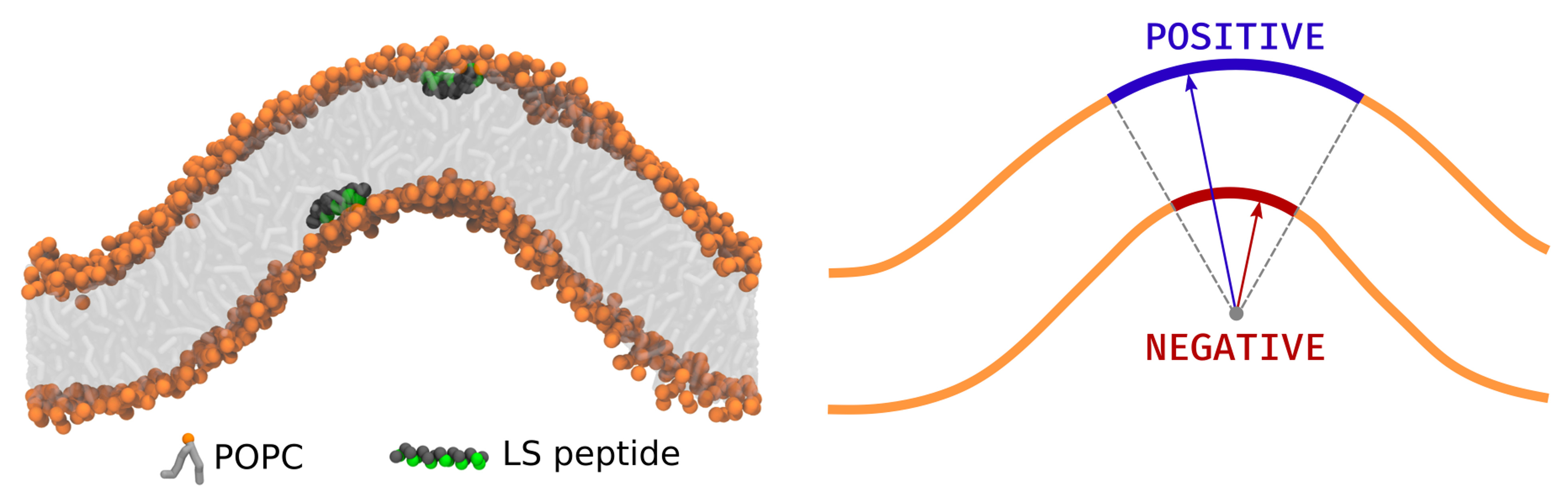
Cellular membranes are not flat, passive barriers; they are dynamic, curved, and compositionally complex interfaces. Many proteins and peptides can sense or generate membrane curvature, allowing them to localize to specific membrane regions and participate in processes such as endocytosis, exocytosis, cell division, organelle remodeling, signaling, and viral budding.
Despite the biological importance of membrane curvature, the rules that govern protein and peptide localization on curved membranes remain incompletely understood. This is because curvature sensing depends on a complex interplay between peptide or protein sequence, molecular shape, insertion depth, hydrophobicity, membrane composition, lipid packing defects, and local membrane stress.
Building on our previous work, we design amphipathic and membrane-active peptides that can distinguish between positive and negative membrane curvature. We also investigate how such peptides can remodel membranes by inducing curvature, promoting fusion, or forming pores. Our goal is to develop peptide sequences that selectively recognize defined membrane geometries and specific cellular membrane environments, including the human plasma membrane. These curvature-sensitive and membrane-remodeling peptides may provide new tools for biotechnology, synthetic biology, targeted delivery, and future therapeutic applications.
Fusogenic Peptides
Membrane fusion is an essential biological process involved in neurotransmission, intracellular trafficking, immune responses, fertilization, and viral infection. It is also central to the performance of liposomes and lipid nanoparticles used for drug and nucleic-acid delivery. However, the molecular mechanisms that control membrane fusion—and how to tune them rationally—remain only partly understood.
Our research focuses on the de novo design of fusogenic peptides for liposomal and lipid nanoparticle formulations. Building on our expertise in membrane-active peptides, peptide–lipid interactions, and multiscale molecular modeling, we develop computational approaches to characterize the key steps of membrane fusion: lipid protrusion, membrane stalk formation, hemifusion diaphragm formation, and fusion-pore opening.
We combine these simulations with advanced biophysical experiments performed in our fully equipped laboratory to test and refine our computational designs. By linking molecular mechanism with experimental validation, we aim to design peptides that efficiently and controllably promote membrane fusion. This work may enable improved strategies for targeted drug delivery, endosomal escape, vaccine formulations, and enhanced therapeutic efficacy.