


Protein-Protein Research
Liquid-Liquid Phase Separation
Liquid–liquid phase separation (LLPS) is a fundamental mechanism of cellular organization in which biomolecules such as proteins and nucleic acids demix from the surrounding solution to form concentrated, dynamic condensates without enclosing membranes. These membraneless organelles compartmentalize biochemical reactions and regulate key cellular functions, including transcription, signaling, stress responses, and gene expression.
Our research combines molecular simulations with experimental and biochemical data to uncover the molecular grammar that controls condensate phase separation. We investigate how sequence patterning, aromatic residues, proline isomerization, local structural motifs, and phosphorylation regulate the formation, maturation, and dissolution of condensates. By understanding these assembly mechanisms, we aim to reveal how biomolecular condensates organize in cell and how their dysregulation may contribute to disease.
Viral Proteins
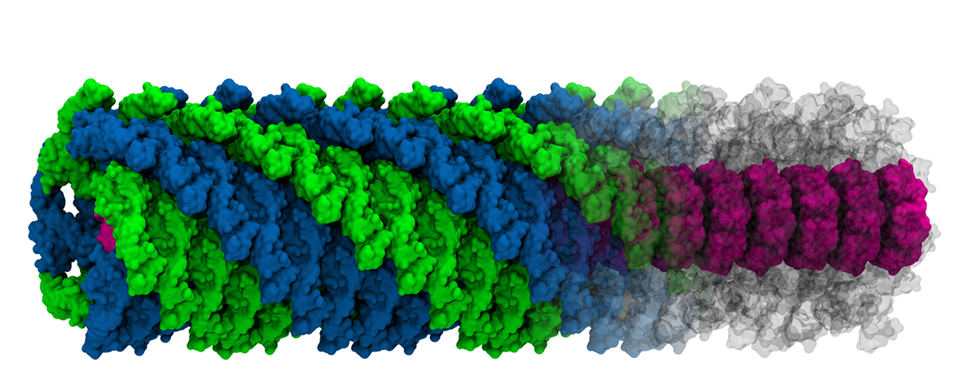
Viral capsids are highly organized protein assemblies that must remain stable outside the host cell but disassemble or open at the right time to release the viral genome. Our research focuses on the protein–protein interactions between viral protomers that control capsid stability, mechanical response, and genome-release pathways.
To investigate these processes, we develop custom highly coarse-grained models of viral capsids and virus-like nanoparticles, which we combine with higher-resolution structural information and cryo-electron microscopy data. These models allow us to determine how protomer interaction strength, interaction range, capsid stiffness, capsid geometry, and genome compactness influence whether cargo release occurs through slow pore formation, localized capsid opening, or rapid capsid rupture.
By comparing molecular simulations with cryo-electron microscopy reconstructions of viruses captured during genome release, we classify distinct release mechanisms and evaluate their efficiency. These insights can guide the design of antiviral strategies that stabilize capsids and prevent genome release, as well as the engineering of virus-like nanoparticles for controlled cargo delivery. In this way, we use the physical principles of viral assembly and disassembly to support both basic virology and therapeutic nanotechnology.